A question worth sitting with
How do I stop being afraid of Revelation?
Revelation is the book most people skip — beasts, plagues, numbers, and doom. But its first line says it is the revealing of Jesus, not a countdown to disaster.
What if the book that has terrified people for centuries was never meant to scare you at all, but to show you how the story ends?
For a lot of us, Revelation is the book we skip. Beasts, plagues, blood, numbers, a great terror looming somewhere ahead. But its very first line tells you what it actually is, and it is not a horror script or a secret code for the end of the world. It is a revealing. And the thing being revealed is not disaster. It is Jesus.
Let's be honest about how most people feel when they open the last book of the Bible. Tense. A little afraid. Revelation has been used to frighten people for generations, turned into charts and timelines and doomsday predictions, mined for clues about microchips and world leaders and the exact date everything falls apart. No wonder so many believers quietly avoid it. It feels less like scripture and more like a coded threat, a book designed to keep you anxious about a future you cannot control. So here is the real question, the one worth actually asking: How do I read Revelation without being afraid of it?
The answer starts with the very first word of the book, which most people read right past. The book is called Revelation, and that word means an unveiling, a revealing, a pulling back of the curtain. The opening line says it plainly: this is the revelation of Jesus Christ. Not the revelation of the antichrist. Not the revelation of the tribulation, the beast, or the end of the world. The whole point of the book, stated in its own first sentence, is to reveal Jesus. Once you know that is what you are reading, the entire thing changes character. You stop hunting for hidden threats and start looking for the one it was written to show you.
Read that again. The book opens by calling itself a blessing, not a warning. It was written to a group of very real, very frightened first-century churches who were being persecuted, some of them killed, under the weight of an empire that looked unbeatable. It was not written to terrify comfortable modern readers. It was written to comfort suffering ones, to lift their eyes above the empire crushing them and show them who actually wins. That is a completely different book than the one fear taught us to expect.
Four ways Christians read it, so you know you're not crazy
Part of what makes Revelation scary is that everyone seems to read it differently and insist their way is the only way. It helps enormously just to know that sincere, faithful Christians have understood this book through four main lenses for a very long time. The confusion you feel is not a sign you are missing something obvious. You are standing in front of a book that has always invited more than one reading.
The Preterist view reads most of Revelation as already fulfilled, describing events in the first century, especially the fall of Jerusalem in 70 AD. On this view, John was writing about his own era's upheavals, not ours.
The Historicist view reads the book as a sweeping timeline of church history, from the apostles all the way to the end of time. The symbols map onto real movements and empires across the centuries.
The Futurist view reads chapters 4 through 22 as still ahead of us, describing end-time events like the Great Tribulation and the return of Christ. This is the view many contemporary teachers, including Pastor Vlad, hold.
The Idealist or Symbolic view reads the book as a timeless allegory of the ongoing battle between good and evil, true in every age. Less about dates, more about the enduring pattern of God's triumph over darkness.
Here is the freeing part. You do not have to have a doctorate or a fixed position on all of this to read Revelation and be fed by it. Faithful people land in different places, and the book still does its work in all of them, because its central message survives every one of these lenses. Jesus wins. That thread runs through the book no matter which way you read the timeline.
Four keys that take the fear out of the reading
Once you know the book is about revealing Jesus, four simple keys make it readable, and each one quietly dissolves a different piece of the fear. These come straight from the way careful teachers, Pastor Vlad among them, walk people through the book.
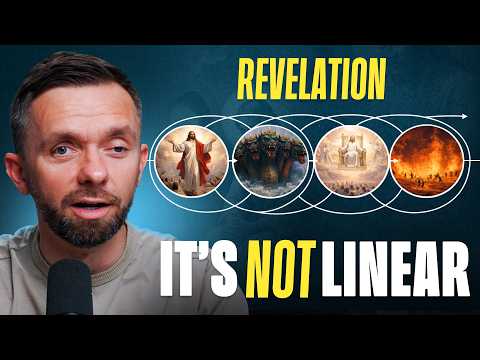
1. It is not a straight-line timeline. This one alone relieves so much anxiety. Revelation is not a chronological countdown where each chapter is the next event on a doomsday clock. It is a series of visions that repeat and spiral, circling back to the same final victory of Jesus from different angles. You are not watching a sequence tick down toward doom. You are seeing the same triumphant ending painted again and again in different colors. When you stop reading it as a countdown, the pressure lifts.
2. Look for contrasts and symbols. The book speaks in word pictures and deliberate opposites: the Lamb against the Beast, the Bride against the Prostitute, the holy city against Babylon. These contrasts are not there to scare you. They are there to make one thing vivid: the choice between God's kingdom and the enemy's counterfeit. Read the symbols as a painting of that choice, not as a puzzle hiding a threat.
3. Read it through the Old Testament lens. Almost every strange image in Revelation is borrowed from the Hebrew scriptures: Exodus, Daniel, Ezekiel, Genesis. The plagues echo Egypt. The beasts echo Daniel. The imagery was familiar, not bizarre, to its first readers. When a symbol confuses you, the key is usually somewhere earlier in the Bible, not in tomorrow's headlines. That single shift moves you from decoding the news to reading scripture with scripture.
4. Keep the ending in view. This is the heart of the whole book. Revelation does not end in fire and loss. It ends in restoration, in paradise restored, with God dwelling permanently among his people. The last two chapters mirror the first two of Genesis: the tree of life returns, the curse is undone, and every tear is wiped away. The book ends where the whole Bible was always heading, in a garden made new. Keep that ending in view and every hard image in the middle reads differently.
Revelation is not a book that ends with the world burning down. It is a book that ends with a wedding, a city of light, a garden restored, and God moving in to live with his people forever. The terror was never the destination. The homecoming was.
Why we read it through fear in the first place
If the book is fundamentally about Jesus winning and paradise being restored, why do so many of us feel dread when we open it? Part of it is that fear sells. Doomsday teaching draws crowds, moves books, and holds attention in a way that quiet hope never quite does. Revelation has been mined for terror because terror is compelling, and generations absorbed that framing without ever checking it against the book's own opening line.
And part of it is the same thing that makes us afraid of God himself. We bring our dread to the text and read it into every symbol. We see a beast and brace for our own destruction, when the book keeps telling the faithful they are safe, sealed, held, and heading home. The fear was never in the book's purpose. We carried it in with us. A frightened reader finds a frightening Revelation. A reader who knows the ending finds something else entirely: the most hopeful book in the Bible wearing dramatic clothing.
How to actually read it without fear
So here is how you stop being afraid of Revelation. Start with the first verse and let it set the terms: this is the revealing of Jesus, not the revealing of your doom. Read it knowing the visions spiral rather than tick down, so you are never watching a countdown. Read the beasts and the plagues as contrasts that make the choice between God and the counterfeit vivid, not as threats aimed at you. Chase the strange images back into the Old Testament where they came from, instead of into the news. And above all, keep the ending in view, because the ending is a garden, a wedding, and a God who moves in to stay.
When you read it that way, the book does the exact thing it was written to do. It lifts your eyes off whatever empire or illness or fear feels unbeatable right now, and it shows you, from a dozen different angles, that Jesus has already won and that the story ends in restoration. The first readers were being fed to lions, and this book was their comfort. It can be yours too.
The Bible opens in a garden, with God walking among his people, and every hard thing that follows is the story of getting back there. Revelation is the last chapter, and it does not end in ashes. It ends at home. You do not have to be afraid of a book whose final word is that every tear gets wiped away and God himself comes to dwell with us. That is not a threat. That is the best news ever put on a page.
The last book of the Bible was never written to frighten you. It was written to show you how the story ends, and the story ends at home.
Revelation means unveiling, and what it unveils is Jesus, victorious, and a creation made new. The fear we feel when we open it was handed to us by a culture that found doom more compelling than hope, not by the book itself, which calls itself a blessing in its opening breath. You do not need a chart, a timeline, or a doctorate to read it well. You need to know what it is for, let the visions spiral toward the same victory, read the symbols as contrasts, trace them back to the Hebrew scriptures, and keep your eyes on the ending.
And the ending is everything. Not fire that consumes the faithful, but a garden restored, a city of light, a wedding feast, and the tree of life growing again with leaves for the healing of the nations. The very last movement of the entire Bible is God wiping away every tear from every eye and moving in to live with his people forever, the way it was always meant to be before anything went wrong.
So open the book. Read it slowly, with the ending in your heart. Let it do what it was written to do, which is not to terrify you but to lift your eyes above everything that frightens you and show you the One who has already won. Revelation is not the story of how the world ends in fear. It is the story of how the whole thing comes home.
Join the conversation
Comments & ideas
Have a thought, a question, or something this stirred up? Leave it below.
Loading comments…
Keep exploring
Related Bible questions
Watch alongside