A question worth sitting with
Revelation — what it actually says
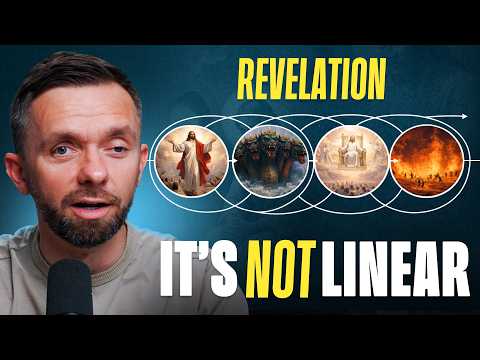
The word means uncovering. Not catastrophe. Not punishment. Not a horror movie you can't look away from. An uncovering — and what's behind the curtain is more hopeful than you were told.
For those of us who grew up with Revelation as a fear-delivery system. The book that scared you was always trying to set you free.
Some of us grew up with Revelation as a fear delivery system. Every fire, every earthquake, every strange news story was evidence that the end was near. Maybe your father kept it open on the nightstand. Maybe a pastor used it to remind you how bad things were going to get before they got better. Maybe you found yourself oddly fascinated by it — the way you can't stop reading something terrible even though it's making you anxious. The doom-scroll before there was doom-scrolling. This is for those of you who picked up that fascination along with the fear, and who deserve to finally hear what the book was actually trying to say.
Let's start at the very beginning. The very first word. In the original Greek — the language the New Testament was written in — the first word of this book is Apokalypsis. You recognize it. We turned it into our word "apocalypse." But what does it actually mean? Not disaster. Not destruction. Not the end of everything. Apo means "un." Kaluptein means "to cover." Apocalypse means uncovering. Disclosure. Pulling back a curtain. Revelation.
Somebody is showing you something. That's the whole book in one word.
And what are they showing you? Not mainly a timeline of disasters. Not a prophecy puzzle to decode before the end. They are showing you — in dramatic, visual, symbolic language — that the world is not what it appears to be. That the things that look permanent are not. That the things that look hopeless are not. That the suffering that feels pointless is not. That God has not left the building. That the story is not over. That it ends well.
So who wrote it?
A man named John wrote it. He tells us he was on an island called Patmos when he received the visions. Patmos was a rocky island in the Aegean Sea — roughly the size of a small town — where the Roman Empire sent people it wanted to silence without killing. John had been exiled there. He was a prisoner.
Think about that. The person who wrote the most visionary, dramatic, hope-filled book in the Bible was a prisoner on a prison island. He was writing to friends and communities back on the mainland who were being persecuted. Some were being killed. Some were being pressured to give up their faith just to survive. Some were getting comfortable with the empire and slowly forgetting who they were.
He was writing to people who needed to know that God could still see them. That what they were going through had meaning. That the side they were on was not the losing side — even though, from where they were standing, it looked exactly like the losing side.
Imagine you have a friend who is very sick in the hospital, and they feel alone and scared. You write them a letter. But the hospital reads all the mail, so you write it in a kind of code — pictures and symbols your friend will understand. And the message underneath all the symbols is: hang on. I can see the whole picture from here. The story doesn't end the way it looks like it's going to end. You're not alone. You're going to be okay. That's Revelation.
The part everyone skips — the seven letters
Before any beasts or seals or dragons appear, Revelation opens with seven letters. Seven specific letters to seven specific, real communities. These are not metaphors. They are towns — Ephesus, Smyrna, Pergamum, Thyatira, Sardis, Philadelphia, Laodicea — in what is now Turkey. Jesus dictates a personal message to each one. Each message is different. Each one meets that community exactly where they are.
This is important because it tells us something about what Revelation is doing. It is not a one-size-fits-all terror broadcast. It starts with the particular. It starts by seeing each community individually, naming their specific situation, speaking directly to their specific struggle. Before there is any prophecy, there is pastoral care.
Ephesus — praise and warning. You're doctrinally solid and you work hard. But you've lost the love you had at the beginning. The faith became a task instead of a relationship. Come back to why you started.
Smyrna — pure encouragement. You're poor. You're being persecuted. You're suffering. I see all of it. Don't be afraid. Stay faithful. What's coming is worth it. No rebuke at all.
Pergamum — praise and warning. You stayed faithful in a hard place. But some of you are making too many compromises with the culture around you. You're blending in when you're supposed to stand out.
Thyatira — praise and warning. Love, service, faith, endurance — all growing. But a teacher in your community is saying it's okay to go along with the idol worship at the trade guilds. The easy road is the wrong road here.
Sardis — mostly warning. Everyone thinks you're thriving. From the outside you look great. But the vitality is gone. You're going through the motions. Wake up. Strengthen what still remains.
Philadelphia — pure encouragement. Small. Seemingly weak. Not much power in the world's eyes. But you kept the word and didn't deny the name. I've placed an open door in front of you that no one can shut.
Laodicea — stern warning. Wealthy. Comfortable. "I don't need anything." This is the community Jesus says he will spit out of his mouth. Comfort had become the whole point. The faith had been swallowed by prosperity.
Look at that list and ask: which of those seven communities does yours feel like? Which one do you feel like, personally? Most of us have lived in more than one at different points. Revelation begins by looking at you and saying: I know exactly where you are.
The symbols — a puzzle, but a solvable one
Here's the thing about the dragons and beasts and bowls and seals that terrified so many of us as children. They were not mysterious to the people who first received this letter. They were images from a shared visual language — the same kind of language the books of Daniel, Ezekiel, and Isaiah used. It's like political cartoons. If someone from the 1800s looked at a modern political cartoon of an elephant and a donkey fighting, they wouldn't know what they were looking at. But we do instantly. The original readers of Revelation had the same fluency with its images.
The dragon — evil itself. Not a literal dragon. The ancient power that has always tried to destroy what God loves.
The beast from the sea — the Roman Empire. Political power that has forgotten it is not God and starts demanding worship it doesn't deserve. In every generation there is something that acts like this beast.
666 — the number of the Emperor Nero's name in Hebrew code. It's not a tattoo or a barcode. It was a way of saying: this specific empire, this specific power, falls short of divine in every direction. Seven is completeness and perfection. Six-six-six is three steps short of seven in every way.
Babylon — Rome. The great city built on seven hills that persecutes the innocent and demands allegiance it has not earned. Every generation has a Babylon. The question Revelation asks is whether you can see it for what it is.
144,000 — not a literal headcount of who gets in. Twelve times twelve times one thousand. Twelve tribes of Israel times twelve apostles times a number representing fullness. It means: the complete community of the faithful. All of them. No one left out who chose to be there.
The number seven appears over fifty times. Seven equals completeness, wholeness. Seven seals, seven trumpets, seven bowls. The message is not that these things happen in a specific sequence. It is that God's response to evil is complete, thorough, and will not leave anything unaddressed.
For those of us who grew up scared of this book
Let's be honest about something. Revelation has been used badly. It has been used to terrify people into compliance. It has been used to make every earthquake and eclipse into evidence that the end was coming and that you'd better get right with God or else. It has been used as a weapon by people who had the interpretation and were happy to make sure you understood how afraid you should be.
Some of us had parents who were genuinely comforted by the idea of the end of the world. Not because they were morbid or strange — but because they were suffering, and the thought that Jesus could return at any moment and make everything right was the one thing that made the days bearable. That is not wrong. That impulse — the longing for an end to suffering, for justice, for rescue — is actually exactly what Revelation is speaking to. It was written to people who were suffering. The comfort it offers is real. The problem is only when the fear of the end gets separated from the hope of what comes after it.
Revelation was not written to make you afraid of the future. It was written to give you the courage to live faithfully in the present — because someone who can see the whole story wanted you to know how it ends.
The word "blessed" appears seven times in Revelation — matching its symbol for completeness and wholeness. Seven specific blessings, scattered through the whole book. The very first verse calls its readers "blessed." The book that gets read as a horror story is actually, at its heart, a pronouncement of blessing over the people who are holding on in the dark.
The part nobody reads — the promises at the end
Everyone talks about the seals and the trumpets and the bowls. Nobody talks about where the book lands. Here is where it lands:
That is the destination. Not fire and punishment as the final word. This. The end of the story is God moving in with his people. Not his people being evacuated to a distant heaven while earth burns — the New Jerusalem descends to earth. Heaven and earth merge. The separation ends. And then comes the most specific promise in the whole book: he will wipe every tear from their eyes. Not a general gesture of comfort. A personal, specific act. Your tears. His hand. One by one.
No more death. The thing that has shadowed every human life since the beginning is removed. The last enemy, as Paul called it, is gone. No more mourning. The grief you carry from every loss, every goodbye, every suffering — it ends. Not papered over. Ended. Healed. No more crying. The tears that kept coming even when you thought you were done — there is a day when they stop. Not because you've stopped feeling, but because there is nothing left to cry about. No more pain. The old order of things passes away. The new order is not heaven instead of earth — it is heaven and earth together, everything God intended from the beginning, finally arrived.
Modern teachers who make this approachable
You don't have to wrestle through Revelation alone. There are people who have spent years making it accessible, stripping away the fear, and restoring the wonder and the hope that was always there.
BibleProject — Tim Mackie and Jon Collins. Tim Mackie has a PhD in Hebrew Bible and spent years as a pastor and professor before co-founding BibleProject. Their animated overviews of Revelation — and their longer podcast episodes on apocalyptic literature — are some of the clearest, most accessible explanations available. They approach Revelation as literature, as theology, and as a book of hope rather than a horror manual. Free on YouTube. Start with their "Revelation Overview" — two short videos, each about ten minutes. Probably the single best starting place.
Rob Bell. Rob has spent his career making the deep things of faith accessible to people who found traditional church hard to inhabit. His podcast has done extended series on Revelation that approach it as a book of liberation and imagination rather than fear. Conversational, warm, often disarmingly simple. Good for people who have church hurt and need a gentler re-entry into these ideas.
N.T. Wright — Revelation for Everyone. Wright is one of the most respected New Testament scholars in the world — former Bishop of Durham, decades of writing for both academics and general readers. Revelation for Everyone is written exactly as the title promises: in plain, accessible language. Wright's central argument is that Revelation is about new creation — about God renewing and restoring this world, not abandoning it. He reads the final chapters as the most hopeful thing in the Bible.
Gregg Braden. Braden comes at prophetic and spiritual texts from a science-and-spirituality angle, exploring the intersection of ancient wisdom and modern understanding. Not a biblical scholar in the traditional sense, but his accessible, awe-filled approach to the biggest questions — who are we, what is this all for, how do we live in uncertain times — connects with people who feel outside the traditional church lane.
What Revelation is actually saying to you right now
The world is full of systems and powers and empires that act like they are permanent and in charge. Some of them are obviously bad. Some of them are seductive and comfortable and hard to see clearly. All of them are temporary.
God has not checked out. He sees everything. The suffering that looks pointless is not pointless. The faithful people who look like they are on the losing side are not on the losing side.
The Lamb — the one who was killed — is the one who holds the scroll. The one who appears to have lost is the one who has actually already won. And everyone who stays connected to that Lamb, who keeps their allegiance there rather than to whatever empire is currently demanding it — they win with him.
Revelation's question for your life is not "when will the end come?" Its question is: who are you loyal to? What are you actually living for? And are you willing to keep living for it even when the pressure is telling you to compromise?
The book that scared you was always trying to set you free
If you grew up using Revelation as a doom-scroll — checking every news story against the prophecy timeline, feeling that anxious dopamine hit of "maybe this is it" — I understand. There is something almost compelling about believing you can see the shape of the end. It makes you feel like you're paying attention. Like you're on the inside of something.
But Revelation was not written to give you anxiety management through end-times forecasting. It was written by a man on a prison island to people who were suffering, to tell them something simple and enormous: God can see what you can't. The story is not over. The ending is better than anything you can currently imagine. Hold on.
The word is uncovering. Revelation. Someone is pulling back the curtain — not to terrify you, but to show you that what's behind it is a throne. And on that throne is a Lamb that was slain and now stands. And he is holding every one of your tears in his hands, along with the specific, personal, impossible promise that one day — one day — he will wipe them all away.
The book that scared you was always trying to set you free.
That is not a horror story. That is the most hopeful thing ever written.
Join the conversation
Comments & ideas
Have a thought, a question, or something this stirred up? Leave it below.
Loading comments…
Keep exploring
Related Bible questions
- Why did Adam and Eve fall — if life was already perfect?
- Adam, Eve, and the weight of the fall
- Where did Cain find a wife — and what was the land of Nod?
- Who is Melchizedek?
- Why so much war in the Old Testament — and why kill the children?
- Why did God threaten to kill Moses — over a foreskin?
- The book of Job — what is it actually about?
- Why all the measurements? The Temple, the Ark, and sacred geometry
Watch alongside