A question worth sitting with
What are 3 things to do when everything is going wrong?
Stop complaining, get into receiving mode, and give thanks before the outcome. Three practices that move your attention off the wreckage and onto the One holding it.
There are seasons when it feels like the wheels are coming off all at once. The job, the relationship, the health scare, the money, the friend who went quiet. Most of us look for the one decision that will fix it all. But some seasons will not be fixed by force. They will only be moved through. What changes first is rarely the circumstance. It is you.
You cannot always change what is happening to you. You can change what you are doing with it, and that turns out to change nearly everything else.
Genevieve Davis wrote a small book called Becoming Magic about exactly this, and her core prescription is startling for how plain it is. Stop complaining. Get into receiving mode instead of grasping. Live in gratitude. She calls the result magic. I would call it something older. What she is describing, in a different vocabulary, is a posture that Scripture has been recommending for thousands of years, and I have watched it work in my own life often enough to stop being surprised by it.
1. Stop complaining
Complaining is how most of us bond with each other. It feels like honesty. It feels like processing. It is usually neither. Complaining is the act of rehearsing what is wrong, out loud, to someone who cannot fix it, which keeps your attention welded to the problem and floods your body with the feeling of it all over again.
Paul, writing from a prison cell of all places, tells the Philippians to do everything without grumbling or arguing, and then in the same letter says he has learned to be content in any circumstance. He is not pretending the cell is comfortable. He is refusing to let his mouth keep him there.
There is a real difference between complaining and telling the truth. Naming a problem to someone who can help, or bringing your grief honestly to God, is not complaining. The Psalms are full of raw lament, and God never rebukes it. The difference is direction. Lament is aimed at God and moves toward release. Complaint is aimed sideways at anyone who will listen, and moves in a circle.
Go seven days without saying a negative thing out loud about your circumstances, your body, other drivers, the weather, or the people who disappointed you. You will fail. Everyone does, usually before lunch on day one. Start the count over and keep going. What you are after is not perfection. It is the shock of discovering how much of your speech was running on autopilot, and how much lighter you feel when the rehearsal stops.
2. Get into receiving mode
Most people spend their whole lives asking and never once switch into receiving. They ask, then they check. They ask, then they grip. And the grip itself, the yearning, quietly broadcasts that you do not have it, which keeps you locked in the wanting instead of the having. The instruction is to ask once, then let go and trust.
Peter puts it even more physically: cast all your anxiety on him. Cast is a throwing word. It implies the thing leaves your hand.
Releasing the expectation is not the same as releasing the desire. You can still want the healing, the reconciliation, the door to open. What you hand over is your grip on the timeline and the method. Most of our suffering in hard seasons is not the situation itself. It is the exhausting work of trying to control an outcome we were never in charge of. That is pushing a wet noodle, and the relief when you stop is immediate.
Asking is easy. Receiving requires you to stop checking whether it arrived. The grip that feels like faith is usually just fear wearing faith's clothes.
Write the thing down on paper. Say it to God once, fully and specifically. Then physically put the paper somewhere out of sight. When the worry returns, and it will within the hour, say a single sentence: I already gave that to you, and I am not taking it back. Then go do the next ordinary thing in front of you. Trust is not passivity. It is doing your part with open hands instead of clenched ones.
3. Give thanks before the outcome
Notice the small phrase buried in that Philippians verse. Present your requests with thanksgiving. Not after the answer. During the asking, while it is still unresolved. Paul tells the Thessalonians to give thanks in all circumstances, and he is careful with his preposition. In all circumstances, not for all of them. You are not required to be grateful that the diagnosis came. You are invited to find something to be grateful for while you are carrying it.
This is not denial, and it is not a spiritual bypass. It is a redirection of attention, which is the only real estate you actually control. Gratitude does not require your situation to improve first. It requires you to widen the frame far enough to notice what is still standing. And that widening is the thing that quietly begins to change what you are able to see, and then what you are able to do.
Every account of a life turning around that I have ever taken seriously has this at the hinge. Not because the universe rewards cheerfulness, but because a person consumed by what is missing cannot see the door that is open. Gratitude clears the fog on the windshield. You still have to drive.
Three specific things, every night, in writing, that were not there yesterday. Specific is the whole trick. Not 'my family,' which the brain will file as generic. But the way the light came through the kitchen window, the person who let you merge, the fact that your body carried you through another day. Do it for thirty days. It is difficult to stay in despair while actively hunting for evidence of goodness, and that is precisely the point.
Why this actually works
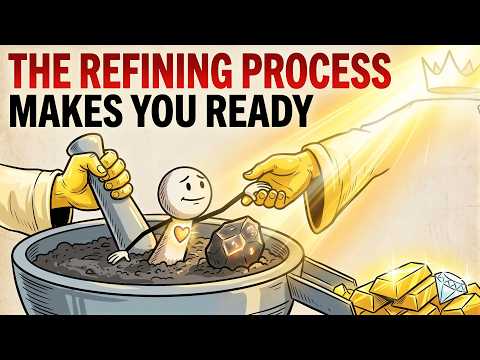
Look at what all three practices are doing. They are not techniques for controlling outcomes. They are all doing the same single thing: moving your attention off the problem and onto God. Complaining fixes attention on the wound. Gripping fixes attention on the outcome. Ingratitude fixes attention on the gap. All three keep you staring at the thing you least want to grow.
That is not naive optimism. It is instruction about where to point the one instrument you fully own. You cannot always choose your circumstances. You can always choose your focus, and your focus turns out to be the lever that moves everything you can actually move.
Davis calls the result magic. Scripture would call it walking by faith rather than by sight. Different words, and I suspect a similar mechanism, because both are describing what happens when a person stops fighting reality and starts trusting the One holding it.
Start where you are standing
If everything feels like it is going wrong right now, you do not need a new five-year plan. You need three small practices you can start before you go to bed tonight. Close your mouth on the complaint. Hand the outcome over and refuse to take it back. Write down three specific things you are thankful for.
None of it guarantees the circumstance changes on your schedule. What it does is change who you are while you are waiting, and that is not a consolation prize. The version of you that comes out of a hard season having practiced these three things is stronger, lighter, and far more useful to God and to everyone around you than the version who white-knuckled it.
And here is what I have watched happen more times than coincidence explains. When a person genuinely stops complaining, genuinely lets go, and genuinely gives thanks in the dark, things start to move. Doors open that were not open. People arrive. Solutions appear from angles nobody was watching. Call it magic if you want. I think it is what happens when we finally get out of the way and let God do what he has been trying to do the whole time.
You cannot control what is happening. You can control what you say, what you release, and what you thank God for. That has always been more than enough.
Join the conversation
Comments & ideas
Have a thought, a question, or something this stirred up? Leave it below.
Loading comments…
Keep exploring
Related Bible questions
- Why so much war in the Old Testament — and why kill the children?
- Why did God threaten to kill Moses — over a foreskin?
- The book of Job — what is it actually about?
- Why all the measurements? The Temple, the Ark, and sacred geometry
- Why did Jesus have to die on the cross?
- Where was Jesus between ages 12 and 30?
- Why did Jesus go to the desert for 40 days — and how could He be tempted?
- Why didn't Jesus try to stop Judas?
Watch alongside