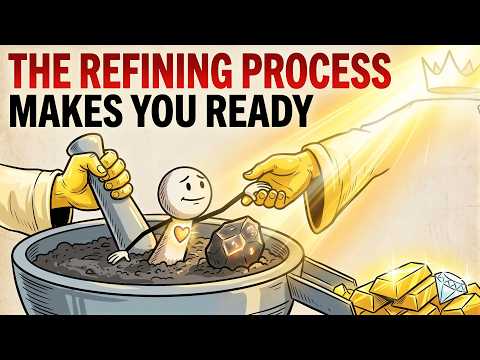
A question worth sitting with
What is God's will?
Have you noticed we only say "it was God's will" when something goes wrong? What if that one worn-out word has quietly made God the villain of our own lives?
We say it at funerals and in hospital hallways. We rarely say it at weddings or promotions. Somewhere along the way, God's will became the label we slap on tragedy, and God became the one holding the blame. What if the phrase itself is the problem, and there is a better word hiding right behind it?
Listen to how the phrase actually gets used. A baby dies, and someone leans in close and says it must have been God's will. A person loses the job they needed, and they tell themselves it was God's will. The scan comes back with a shadow on it, the marriage falls apart, the accident happens on an ordinary Tuesday, and there it is again. God's will. We reach for those three words almost exclusively in the presence of pain. They have become the thing we say when we have run completely out of explanations and we need somewhere to put the weight of what just happened.
And here is the quiet, uncomfortable thing underneath that habit. When we only invoke God's will in the middle of suffering, we are, without quite admitting it, handing God the blame. The baby did not just die. God willed it. The cancer did not just appear. God wanted it there. We think we are finding comfort, and in a way we are, because a God who caused it is at least a God who is in control. But look at the cost of that comfort. We have made God the author of every terrible thing, the cosmic decision-maker who signed off on the worst moment of your life.
Notice what we do on the other side. When something wonderful happens, we rarely say it was God's will. We say praise God, or we say we are grateful, or we say we feel blessed. The good gets a thank you. The bad gets assigned. And over a lifetime of talking that way, a lopsided picture forms, one where God's will is almost a synonym for the thing that hurt. That is a strange and quietly corrosive way to think about the being who is supposed to be the source of all love.
The Problem Is the Word "Will"
Here is the shift that changes everything, and it is almost embarrassingly simple. What if we stopped calling it God's will and started calling it God's plan?
Those two words carry completely different weight, even though we use them almost interchangeably. Will sounds like a verdict. It sounds like a decision handed down, a single moment where God looked at your situation and chose the outcome, thumbs up or thumbs down. Will is a gavel coming down. But plan is something else entirely. A plan is a trajectory. A plan has movement in it, and direction, and a destination. A plan implies that the hard chapter you are in right now is not the whole story but a part of a larger arc that is still unfolding.
"God's will" sounds like a verdict. A single decision, handed down, done. It freezes the terrible moment into a final answer and stamps God's name on it. It answers the question who is responsible for this, and the answer it gives is God. No wonder it feels like blame. That is exactly what it is.
"God's plan" sounds like a trajectory. Movement, direction, a destination still ahead. It holds the same hard moment inside a larger arc that has not finished. It answers a different question, where is this going, and leaves room for meaning that has not arrived yet. The pain is real, but it is a chapter, not the verdict.
Will makes God the judge who sentenced you. Plan makes God the author who is still writing. Same events. Completely different God.
This is not word games or positive-thinking fluff. It is a genuine reframe of who God is in the story of your suffering. And only one of those Gods is worth trusting when the worst happens.
Why the Pain Might Be Part of the Plan, Not a Glitch in It
But this raises the real question, the ancient one. Why is there suffering at all? And why do good people suffer, the ones actually trying to do right, walking the path of most resistance precisely because they want to live well? If God has a plan, why does the plan seem to run straight through so much pain?
Here is a possibility worth taking seriously. What if the pain is not a flaw in the plan but a feature of it? Not because God is cruel, and not as some pie-in-the-sky reward you earn by suffering enough down here. Something more built-in than that. What if certain things simply cannot be known any other way except through their opposite?
Darkness is how you know light. Wet is how you know dry. Pain is how you know relief. Loss is how you know love. Failure is how you know success.
This is not a metaphor. It is closer to a law of how experience actually works. Contrast is the mechanism by which anything becomes knowable at all. And if that is true, then a plan designed to grow real beings, beings who genuinely know love and light and relief rather than just holding the words, would have to include their opposites. Not as punishment. As the only way the lesson could possibly land.
Which turns the whole question of suffering on its head. What if what we are actually here to do is to appreciate? To learn, in the deepest experiential way possible, what it truly is to contribute to an expanding universal store of knowledge and wisdom. A soul that has known loss loves differently. A soul that has failed appreciates grace differently. The pain is not the price of admission to some distant heaven. The pain is part of how the plan grows you into a being capable of the very things you long for.
You cannot carve depth into a soul that has never been touched by anything hard. Not suffering as a toll you pay, but suffering as the chisel.
Maybe We Make It Harder Than It Was Meant to Be
Here is a thought that stings a little. Maybe we attract more pain by clenching so hard against it. Maybe we crave relief so desperately that we keep manufacturing the very tension we are trying to escape. Maybe the abundance we want is on the other side of a risk we refuse to take, so we stay stuck, pushing against a plan that was trying to move us all along. So much of our suffering is not the plan itself. It is our resistance to the plan.
There is an old image for this. Trying to push a wet noodle. You cannot push a wet noodle forward. It buckles and folds and goes nowhere no matter how hard you shove. That is most of us, most of the time, trying to force outcomes through sheer effort and will, exhausting ourselves against situations that will not be pushed. What if the whole time, the invitation was to stop pushing.
When something bad happens, what if you could see it as part of the plan. And when something good happens, see it as exactly the same, part of the same unfolding arc, no longer splitting your life into things you blame God for and things you merely thank him for. Both are the plan. Both are moving you somewhere. Life gets lighter the moment you stop trying to carry the steering wheel and the map and the engine all by yourself.
The Easy Yoke Was Always About This
This is one of the most quietly confusing things Jesus ever said, and it is worth slowing down on. My yoke is easy. My burden is light. But this is the same man who was heading toward a cross. How do you square an easy yoke with a life that ended in execution?
Maybe he was not talking about circumstances at all. Maybe the easy part was never about the road being smooth. Maybe what he meant is that giving way to God's plan is easy in the specific sense that it is lighter than the alternative. The alternative is trying to run the entire universe from inside your own small head, fighting every hard thing, blaming God for the pain and thanking him only for the pleasure, pushing your wet noodle up the hill of a life you were never designed to control by force. That is the heavy yoke. And most of us wear it our whole lives without ever noticing we were the ones who strapped it on.
The easy yoke is the yoke of trust. It is what happens when you finally let go of the need to understand and control every chapter, and you put your weight down into the knowledge that the plan is good even when the moment is not. The load does not vanish. It gets lighter, because you are no longer carrying the part that was never yours to carry.
Let It Be Light, and Trust the Destination
So here is the whole thing, gathered up. Stop calling it God's will, with all the blame and finality that word smuggles in, and start calling it God's plan. Good or bad, there is a purpose, and the purpose is not some distant reward you grind toward through gritted teeth. The purpose is the becoming itself, the experiential growth that adds something real and permanent to the greatness of eternity.
And in the middle of it, let your yoke be light. You do not have to understand the hard chapter to keep walking it. You do not have to assign blame or manufacture meaning or push the wet noodle one more inch. You only have to let go, get out of your own way, and let yourself experience whatever it is that contributes to the growth of your soul.
Think bigger and deeper about what becomes possible when you stop fighting the plan and start trusting it. More abundance on the far side of the risks you were too afraid to take. More love because you finally let yourself know loss. More light because you walked through the dark instead of just cursing it. This is not passive. It is the most active trust there is, the daily choice to believe that the One writing the story is writing it toward good, and to hand him the pen.
It was never God's will as a verdict handed down. It was always God's plan, still unfolding, still good, still carrying you toward something you could not have become any other way.
We reached for God's will only in the dark, and without meaning to, we made God the villain of our own lives. But the word was wrong the whole time. It was never a gavel. It was a trajectory. Every chapter is part of a plan that is moving you toward depth you could not reach in comfort, toward a knowing of love and light that only contrast could teach.
So let it be light. Stop pushing the wet noodle. Stop splitting your life into what you blame God for and what you thank him for, and start seeing all of it as one unfolding gift you do not yet fully understand. Take the easy yoke, which was never about an easy road but about the rest that comes when you finally trust the One holding the map.
Because the promise at the end of the path was never that it would be painless. The promise was that if you walk it in trust, you will one day hear the only words that could ever make the whole journey worth it. Well done, my good and faithful servant. Not because you controlled it. Because you trusted the One who did.
Join the conversation
Comments & ideas
Have a thought, a question, or something this stirred up? Leave it below.
Loading comments…
Keep exploring
Related Bible questions
Watch alongside